Audi R8 Hyper Black Edition
Anderson Germany, one of Europe's lesser known tuning firms, has set their sights on the flagship version of the Audi R8 Hyper Black Edition. The tune includes both aesthetic modifications and a few modest performance upgrades.
BAC Mono
Briggs Automotive Company, launches with the BAC Mono - a high-tech single-seater. Powered by a 2.3-litre 230bhp Cosworth engine, the £80k BAC Mono is the first serious attempt to produce a single-seater driving experience for the public road.
BMW 6-Series Sportcar Coupe
The BMW 6 Series Coupe has a classy and comfortable cabin, and it's available with excellent engines. The diesel is particularly impressive, combining strong performance with average economy of more than 50mpg.
Brabus BiTurbo 700
Powered by the new BRABUS twin-turbo engine with 700 hp (690 bhp) and a peak torque of 850 Nm and clad in the thrilling WIDESTAR wide-body version the Mercedes SLS AMG from BRABUS ascends to a new level in the league of super sports cars.
Koenigsegg Agera R
The Agera R built upon the features and functionality of the Agera with new, unique solutions to enhance both performance and visual appearance even further. The first Hypercar manufacturer to take steps toward green technology with the release of the biofuel CCXR in 2007.
McLaren MP4-12C GT3 Racer
The GT3 racer features the same 3.8-liter twin turbo V8 engine (known internally as the M838T) but with just 493bhp instead of the series 592bhp. Also gets a race suspension and borrows some F1 technology such as for the steering wheel, seats, tires and electronic systems.
Porsche 918 Spyder
The Porsche 918 Spyder is a mid-engined plug-in hybrid sports car designed by Porsche. The Spyder is powered by a naturally-aspirated 4.6 litre V8 engine, developing 608HP, with two electric motors delivering an additional 279HP for a combined output of 887HP.
2010 SpeedArt BTR II 580 Sports Car
SpeedART Turbo Porsche Panamera Sports Car Saloon 4.8 liter twin turbo V8 Engine.

The kit brings the total output to 520bhp. The sprint of the 4.8 liter twin turbo V8 will probably be hit the 4.0 seconds. Top speed will not increase a lot but 303km/h (190mph) isn’t too bad for a four-door sedan.Set to be officially unveiled at the Essen Motor Show, the range topping PS9 features 650 hp and 890 Nm of torque thanks to bigger turbochargers, a sport exhaust system (with a sound switch), a sport catalyst, and a revised ECU. These changes enable the car to accelerate from 0-62 mph in 3.5 seconds, before hitting a top speed in excess of 200 mph. If 650 hp is too hot to handle, the company also offers more modest performance packages that allow the engine to produce 550 and 600 hp.SpeedART claims that the most powerful version of the car accelerates from zero to 100km/h (62mph) in 3.5 seconds and goes on to achieve a top speed in excess of 320km/h or 200mph.

In terms of styling, the PS9 is outfitted with an aerodynamic body kit which consists of a front chin spoiler, hood vents, a rear diffuser, a roof spoiler, a modified rear bumper (with air outlets), and aggressive side skirts. Other design details include 22-inch three-piece 'LSC FORGED' wheels and the aforementioned sport exhaust system (available in polished stainless steel or matt black).Inside, the cockpit will get a SpeedART steering wheel with F1-shift paddles, real carbon-fiber trim and accents, new leather upholstery with colored stitches and a revised instrument panel.At the back, we see a new bumper, and the trapezoidal exhaust pipes. A new rear spoiler will also be mounted.

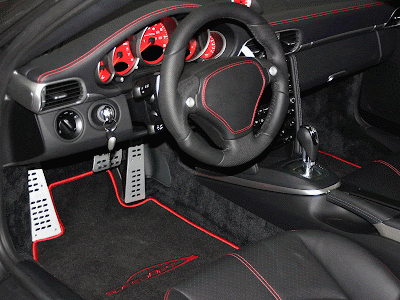
For the interior, SpeedART added a sport steering wheel with F1-shift paddles (which can be outfitted with aluminum-, wood- or carbon fiber inlays), carbon fiber trim, contrast stitching on the door panels and seats, revised instrument dials, and exclusive floor mats.
SRS Aerokit SpeedART The Sports Car Porsche Cayman a Sporty and Elegant.
Unlike many bodykits which radically alter the appearance and persona of the car - sometimes for the good, but all to often for the bad - the SRS Aerokit is extremley in tune with the overall shape of the Cayman.The aerodynamic modifications include a 3-piece front chin spoiler - which provides additional downforce over the front axle, new deeper sideskirts, and an adjustable rear spoiler which has a distinct racing look to it. SpeedART have certainly taken the 'less is more' approach to design, and it's paid off.

The new Boxster and Cayman are significantly more fuel-efficient than their predecessors. The new 2.9-litre Boxer engine sips 8.9 litres of fuel per 100 kilometres (combined) – 11 per cent less than the former models with Tiptronic S. Reducing fuel consumption by 16 per cent to 9.2 litres/100 kilometres, the 3.4-litre versions with PDK offer an even greater saving.
For the first time, both models are available with a Lights Package featuring bi-xenon headlights, dynamic curve lights and LED daytime driving lights. Replacing the foglamps, these light units are made of four LEDs positioned next to one another on the Boxster, while on the Cayman four LEDs are arranged in round light units like the eyes of a dice.

PDK cars’ acceleration is even more dynamic with one of the optional Sports Chrono Packages featuring Launch Control for maximum acceleration from a standing start, while the Race Track Gearshift Strategy offers the fastest possible shifting on the track. With Launch Control, the respective models accelerate from a standstill to 100 km/h another 0.2 seconds faster. (For instance, the Cayman S with PDK and Launch Control accelerates to 100 km/h in 4.9 seconds, while the base Boxster with its new six-speed manual gearbox completes the same exercise in 5.9 seconds.)A new suspension set-up gives the new models a combination of even greater driving dynamics and enhanced comfort. Steering forces have been further reduced, giving the Boxster and Cayman even more agile and spontaneous steering behaviour.

The wheels come in new designs and are half an inch wider on the Boxster and Cayman than in the past in order to accommodate the larger brake system from the S models on the front axle. All Boxster and Cayman models feature the latest generation of Porsche Stability Management (PSM), with two additional functions: Brake Pre-Loading and Brake Assistant.
Whenever the driver lets go of the gas pedal very quickly – which is typical of an upcoming emergency braking manoeuvre – the PSM control unit builds up an appropriate level of pressure on the brakes before the driver even presses down the brake pedal, moving the brake pads slightly towards the discs, which significantly improves brake response and shortens stopping distances accordingly.