Audi R8 Hyper Black Edition

Anderson Germany, one of Europe's lesser known tuning firms, has set their sights on the flagship version of the Audi R8 Hyper Black Edition. The tune includes both aesthetic modifications and a few modest performance upgrades.

BAC Mono

Briggs Automotive Company, launches with the BAC Mono - a high-tech single-seater. Powered by a 2.3-litre 230bhp Cosworth engine, the £80k BAC Mono is the first serious attempt to produce a single-seater driving experience for the public road.

BMW 6-Series Sportcar Coupe

The BMW 6 Series Coupe has a classy and comfortable cabin, and it's available with excellent engines. The diesel is particularly impressive, combining strong performance with average economy of more than 50mpg.

Brabus BiTurbo 700

Powered by the new BRABUS twin-turbo engine with 700 hp (690 bhp) and a peak torque of 850 Nm and clad in the thrilling WIDESTAR wide-body version the Mercedes SLS AMG from BRABUS ascends to a new level in the league of super sports cars.

Koenigsegg Agera R

The Agera R built upon the features and functionality of the Agera with new, unique solutions to enhance both performance and visual appearance even further. The first Hypercar manufacturer to take steps toward green technology with the release of the biofuel CCXR in 2007.

McLaren MP4-12C GT3 Racer

The GT3 racer features the same 3.8-liter twin turbo V8 engine (known internally as the M838T) but with just 493bhp instead of the series 592bhp. Also gets a race suspension and borrows some F1 technology such as for the steering wheel, seats, tires and electronic systems.

Porsche 918 Spyder

The Porsche 918 Spyder is a mid-engined plug-in hybrid sports car designed by Porsche. The Spyder is powered by a naturally-aspirated 4.6 litre V8 engine, developing 608HP, with two electric motors delivering an additional 279HP for a combined output of 887HP.

Showing posts with label Opel. Show all posts

Opel Amphibian Sport Cars Icona Concept

Opel Amphibian Sport Cars Icona Concept
The Opel Icona Concept Cars is a design study of a futuristic amphibian electric vehicle with a sporty design and retracteable wheels. Keeping such scenario in mind, Swedish designer Juan Pablo Bernal P has designed a futuristic vehicle for the year 2050 that moves on both land and water with equal efficiency. Called the “OPEL ICONA,” the V-shaped commuter vehicle features an aerodynamic body to ensure minimal air resistance for better performance in all conditions. The V shaped dynamic design uses distinctive shapes, forms, patterns and proportions which are express the sporty and leisure-oriented character of the vehicle.
Running on natural sources of energy, the all-electric vehicle generates power from electric motors to allow a clean and green drive. The zero-emission car would not only allow a sustainable drive but also become a means of entertainment to create a special bond between the family members as well as society.
The Opel Amphibian Sport Cars Icona Concept is a hybrid car that can traverse land and sea is nothing new despite being the stuff of dreams at least half a century ago, but this concept cars takes things to a whole new level. It can transport an adult and a child. The Opel Icona project was developed in collaboration with Opel by Juan Pablo Bernal at the Umea Institute of Design, Sweden.
Opel Amphibian Sport Cars Icona Concept
Opel Amphibian Sport Cars Icona Concept features two modes of operation Viz. Land mode and Water Mode to run on ground and water respectively. When the vehicle runs on the ground the sail remains wrapped in the storage area; however, as soon as the occupant puts the vehicle on the water mode the sail retracts and the wheel arms rotate inboard to reduce drag, thus enabling this vehicle to cruise on water with the same speed and elegance.
Opel Amphibian Sport Cars Icona Concept
About the Designer:
Juan Pablo Bernal is Colombian Designer with a Bachelor in Transportation Design from Instituto Europeo di Design (2003-2006) and a MA Degree in Transportation Design from Umea institute of Design in Sweden.
Among his working experiences are internship at the GM Europe Design and at Scania, Sweden.
Opel Amphibian Sport Cars Icona Concept

2011 New Opel Astra GSI Concept Cars Third Millennium

The new Opel Astra GSi will be unveiled in October at the Paris Auto Show and will go on sale later this year or early in 2011. The 2011 Opel Astra GSi will feature various new design elements, including a re-styled front bumper, new wheel arches, a small rear diffuser and double exhaust pipes.
2011 New Opel Astra GSI Concept Cars Third Millennium
Opel fans al already asking when will the new Astra GSI will make its debut. Today we have the answer for them: the new 2011 Opel Astra GSI will make its debut this autumn at the Paris Motor Show, according to the latest reports from Auto Motor und Sport.
The new Opel Astra GSi 5-door layout back to talk about himself, with eloquent spy photos. The famous symbol will return to sport compact Russelsheim later this year. In fact, the Astra GSi will officially introduce yourself to October at the Paris Motor Show and will be sharing the catwalk in Paris with the new Sports Cars Tourer estate.
The new vehicle will carry, as expected, a 2.0-liter Turbo engine which will deliver around 190 hp… we do hope that this will get at least 200 hp in order to take on the Vw Golf GTI. Regarding the OPC version this will carry over 240 hp. The new Astra GSI will also come with a new body kit which will include wider wheel arches, a new front and rear bumper, new side sills, dual exhaust pipes and a dual-tone interior with Recaro sport buckets. Most sources say the 2011 Opel Astra GSi will only be available in the 5 door body style. The 3 door will be sold only as a OPC / GTC.
The new Opel Astra GSi be the top version of the variant 5-door, while the symbol OPC will be given only to the three-door GTC. The 2011 New Opel Astra GSi third millennium will be equipped with the 2.0 Turbo petrol engine, whose maximum should be around 190-200 horses. The Astra OPC boasts a 2.0-litre turbocharged motor with 177kW. The GSI should feature about 140kW or so.
The sports chassis will be recognizable to the wider wheel arches and front bumper changed. At the rear, as well as the letters GSi, Opel Astra in this version will be distinguished for the double exhaust. Even in the cockpit there are specific characterizations, such as two-tone sport seats.
The Astra GSi price will be announced at a later date.

New Opel Trixx City Car Concepts

car news, opel, opel city car, opel trixx, 2010, 4wheels news, automakers, categories, economy cars, europe, vauxhall, year, zone

As you may know already Opel/Vauxhall is currently working on a new city car which will be based on the 2004 Trixx Concept car unveiled at the Paris Motor Show. What we do know now, is that GM’s upcoming city car will offer a high level of finish and sophistication, according to new Vauxhall/Opel boss Nick Reilly. The new car will be very well finished and sophisticated but will also offer a wide choice of options, as shown by the Mini, Fiat 500 and Toyota iQ. “We’ve learnt how to make money on small cars in Asia,” said Reilly.

car news, opel, opel city car, opel trixx, 2010, 4wheels news, automakers, categories, economy cars, europe, vauxhall, year, zone

car news, opel, opel city car, opel trixx, 2010, 4wheels news, automakers, categories, economy cars, europe, vauxhall, year, zone

car news, opel, opel city car, opel trixx, 2010, 4wheels news, automakers, categories, economy cars, europe, vauxhall, year, zone

car news, opel, opel city car, opel trixx, 2010, 4wheels news, automakers, categories, economy cars, europe, vauxhall, year, zone

car news, opel, opel city car, opel trixx, 2010, 4wheels news, automakers, categories, economy cars, europe, vauxhall, year, zone

car news, opel, opel city car, opel trixx, 2010, 4wheels news, automakers, categories, economy cars, europe, vauxhall, year, zone

car news, opel, opel city car, opel trixx, 2010, 4wheels news, automakers, categories, economy cars, europe, vauxhall, year, zone

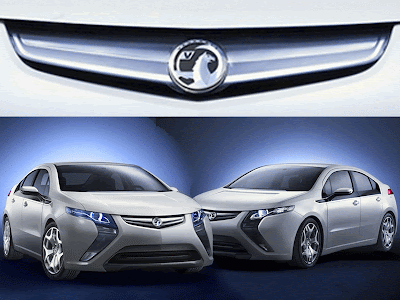
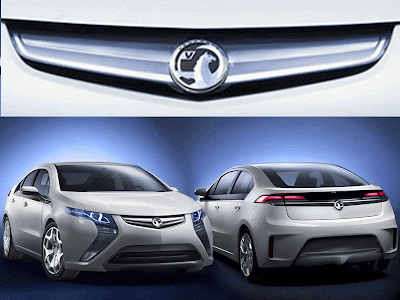
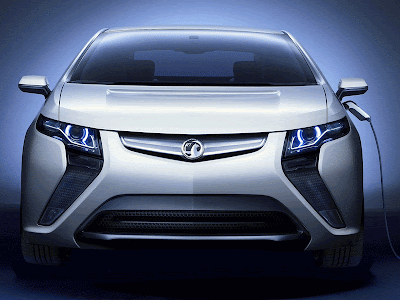
2011 Opel Vauxhall Ampera Plug-in Hybrid

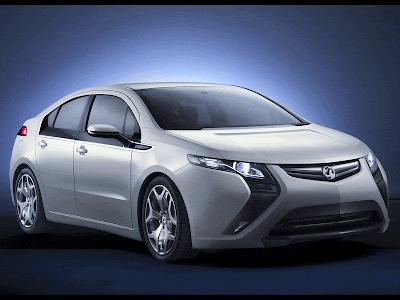
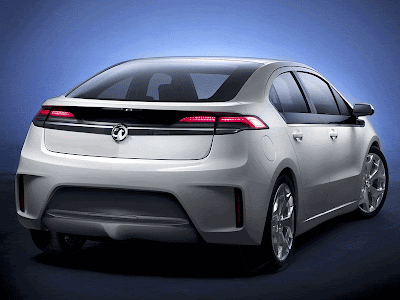
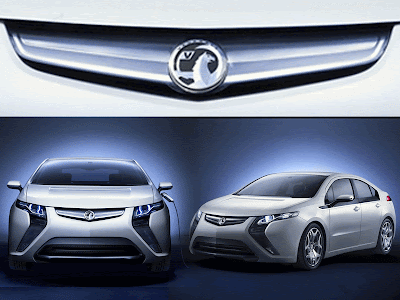
The most enlightening spy photos of the production version of the 2011 Opel Ampera plopped in our inbox today. At first we thought it was just the concept model out testing, but a closer look at the completely undisguised Ampera with the German license plates revealed that this is the actual production model that's due to go on sale in Europe and the UK (as a Vauxhall) in late 2011.
2011 Opel Vauxhall Ampera Plug-in Hybrid
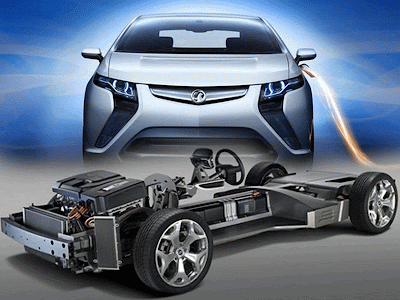
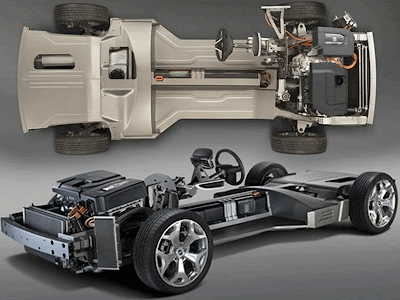
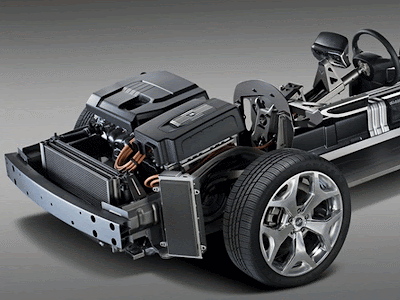
Vauxhall Ampera will be unveiled along with Vauxhall Meriva compact MPV at the Geneva Motor Show 2010. Vauxhall Ampera, schedule for production late next year, is a five-door four-seater with same design DNA as Astra and the Car of the year-winning Insignia. Ampera uses extended-range electric vehicle (E-REV) technology. E-REV uses electricity as its primary power source, supplemented by a small engine to generate electricity for its motors when electric power runs low. This helps the Ampera overcome the ‘range anxiety’ issues associated with pure electric cars.
2011 Opel Vauxhall Ampera Plug-in Hybrid
Unlike other conventional propulsion systems, E-REV uses electricity as its primary power source, supplemented by a small engine to generate electricity for its motors when electric power runs low. This helps the Ampera overcome the ‘range anxiety’ issues associated with pure electric cars. Vauxhall will unveil not one, but two cars at this year’s Geneva Motor Show on March 2, with world premieres of the all-new Meriva compact MPV and a futuristic concept car, which is set to boost the company’s credentials as a leader in environmental vehicles.
2011 Opel Vauxhall Ampera Plug-in Hybrid
A quick recap of the details we already know, the Ampera will use the same plug-in hybrid gasoline-electric drivetrain as the Volt. It mates a powerful electric motor and a 16-kWh, lithium-ion battery pack to a 75HP 1.4-liter gasoline engine. But unlike conventional hybrids that use gasoline engines to power the wheels when the battery is depleted, the Ampera uses the petrol unit to generate electricity for the electric motor that always drives the (front) wheels. Owners will be able to charge the battery pack with a home outlet and drive for about 64km or 40 miles before the gasoline engine-generator kicks in to extend the Ampera's range to more than to more than 300 miles or 480 kilometers.
2011 Opel Vauxhall Ampera Plug-in Hybrid
Bolstering this message still further at the show will be the groundbreaking Ampera extended-range electric vehicle and Vauxhall’s most economical production car to date, the latest Corsa ecoFLEX.
2011 Opel Vauxhall Ampera Plug-in Hybrid
‘Vauxhall is covering all bases at Geneva,’ said Duncan Aldred, Vauxhall’s Managing Director. ‘With the Meriva, we have a unique and innovative take on family motoring, but the concept car and Ampera prove that we are truly at the forefront of environmental technology. These vehicles also show that their versatility and efficiency doesn’t come at the expense of stunning design.’

2010 Opel Flextreme GT/E Concept with E-REV Drive System

Think of the Opel Flextreme GT/E concept as a bigger Chevrolet Volt (or Opel Ampera if you're European). The idea behind this concept, which will debut at the Geneva Motor Show (March 4 - 14, 2010), is to show how the Volt's extended-range electric vehicle drivetrain can be used in a larger vehicle, in this case a mid-size five-door hatchback. And it will boost the company's credentials as a leader in green technologies, offering expressive design with efficient environmental performance - and engineered with German precision.
2010 Opel Flextreme GT/E Concept with E-REV Drive System
In Opel's strategy for achieving more independence from fossil fuels, electricity plays a key role. The 4.7-meter long Opel Flextreme GT/E Concept illustrates how extended-range electric vehicle (E-REV) technology can be plugged into large or mid-size vehicles, as well as compact cars such as the upcoming Opel Ampera. Opel calls this strategy e-mobility unlimited: adapting the highly efficient E-REV drive system - which removes the limitations of battery-only power - to vehicles across all market segments. To enjoy zero CO2 driving emissions Opel-style, the Flextreme GT/E concept shows that size doesn't matter.
2010 Opel Flextreme GT/E Concept with E-REV Drive System
The purposeful design also enables the Opel Flextreme GT/E Concept to achieve a projected drag co-efficient of just 0.22, which helps it reach a 200 km/h-plus top speed as well as conserve energy and extend its driving range. Stand-out visual features include a low and wide stance, wing-shaped lights front and rear, a distinctive nose and grille, floating C-pillars and muscular, sculptured bodywork.
2010 Opel Flextreme GT/E Concept with E-REV Drive System
The clean, frontal styling features a low hood line and an extended nose section, which is clasped by wing-shaped, signature LED headlamps. These are deeply carved into the front fenders and across the hood line. The new trapezoidal grille execution is slim but bold. The prominent wing-shaped chrome bar carries a large Opel emblem, which doubles as a socket for charging the Opel Flextreme GT/E Concept's battery pack. The upper section of the grille is used to admit cooling air, the lower portion being covered by a translucent panel. The absence of additional air intakes allows a low frontal area for aerodynamic efficiency and also enables the Opel Flextreme GT/E Concept to meet future pedestrian protection requirements.
2010 Opel Flextreme GT/E Concept with E-REV Drive System
In profile, the Opel Flextreme GT/E Concept is distinguished by innovative, stubbed C-pillars. This floating design allows the glasshouse to be extended rearwards under the arching roofline, emphasizing the flowing lines of the side body. The car's dynamic character is further underlined by a fresh expression of Opel's signature blade motif, now a swooping swage line from the base of the C-pillar into the lower front fender. The translucency of the fixed glass panel in the center of the roof is adaptive, allowing sunlight to warm the interior in the cold of winter, but darkening for coolness in summer. A duct at the rear edge of the roof is for additional cooling of the battery and electronic components.
2010 Opel Flextreme GT/E Concept with E-REV Drive System
Integral to the Opel Flextreme GT/E Concept's expressive looks is the efficiency of the design execution. The small frontal area, low roof height (1308 mm) and a flat, enclosed underbody all enable the car to cleave the air with a minimum of disturbance. The 21-inch alloy wheels are relatively narrow, to reduce wind resistance, and fitted with 195/45, low rolling resistance tires. Clear, flush-mounted trim inserts also minimize air turbulence.
2010 Opel Flextreme GT/E Concept with E-REV Drive System
The Opel Flextreme GT/E Concept also explores the potential for active shape shifting. At speeds above 50 km/h, a vertical panel extends along the body from the air extraction slot behind each rear wheel-arch. These 350 mm-long side spoilers guide high-speed airflow around the rear corners of the car, further reducing the amount of turbulence.
2010 Opel Flextreme GT/E Concept with E-REV Drive System
Mass reduction measures for the body include the use of lightweight, carbon composite outer panels, polycarbonate window glazing and aluminum alloy structural components. Compared to conventional materials, these offer a 40 percent weight saving which further contributes to reduced energy consumption and an increased driving range.
The efficient concept also includes GM's ground-breaking E-REV drive system, already developed for the Opel Ampera. The Opel Flextreme GT/E Concept shows the versatility of this technology by displaying it in a larger, mid-size vehicle format.
2010 Opel Flextreme GT/E Concept with E-REV Drive System
Despite its greater size and a maximum speed of more than 200 kilometers per hour, the Opel Flextreme GT/E Concept is projected to offer performance similar to that of the Ampera: a battery-powered driving range of up to 60 km - with zero CO2 tailpipe emissions - and a total range of more than 500 km. Average fuel consumption is estimated at 1.6 l/100 km, with CO2 emissions of less than 40 g/km. Unlike a hybrid vehicle, the wheels of the Opel Flextreme GT/E Concept are powered at all times by electricity. For typical journeys up to 60 km, energy is supplied by a T-shaped lithium-ion battery pack located under the floor and rear seat.
2010 Opel Flextreme GT/E Concept with E-REV Drive System
However, unlike a battery-only electric vehicle, the Opel Flextreme GT/E Concept eliminates any possibility of range anxiety through fear of being stranded without power. The small gasoline engine/generator is seamlessly engaged to provide electricity whenever the battery's supply becomes depleted. In this mode, the driving range is extended to more than 500 km, until the plug-in battery pack can be recharged or the car is refueled. The motor in the electric drive unit delivers a substantial 370 Nm of instant torque, giving lively performance and projected zero to 100 km/h acceleration in less than nine seconds.
2010 Opel Flextreme GT/E Concept with E-REV Drive System
The Flextreme GT/E concept is a further step in Opel's unfolding strategy for the electrification of the automobile, which includes a wide portfolio of products using battery, extended-range, hybrid and fuel cell technologies.

Opel Insignia OPC Sports Tourer


Post by: Automotive

- Top power: High performance station wagon must complete 10,000 km on Nürburgring
- Top package: 325 hp, 435 Nm, Adaptive 4x4 and 1530 liters load capacity
- Top points: Insignia OPC sedan testing passed with flying colors

Rüsselsheim/Nürburgring. The Insignia OPC Sports Tourer will hit dealerships later this year, but first it has to go through hell – the Green Hell of the Nürgurgring's Nordschleife, considered the toughest, most demanding and dangerous race track in the world.

Opel engineers insist that all vehicles in their OPC range complete a rigorous 10,000 kilometer testing around the 20.8 km Nordschleife of the Nürburgring, dubbed the Green Hell by legendary race car driver Jackie Stewart. Just a few days ago, the Insignia OPC sedan finished the challenge with no problems.

“The Insignia OPC sedan raced 487 laps for 12 days at some top speeds flawlessly. This kind of performance and quality is what we expect from all our Opel cars,” says Hans Demant, Managing Director of Opel.

The Opel Insignia OPC Sports Tourer boasts a 325 hp/239 kW, 435 Nm 2.8-liter V6 Turbo engine for maximum power. It features high-tech elements, like a lower, reworked mechatronic chassis with FlexRide, an Adaptive 4x4 transmission with an electronic rear limited slip differential (eLSD) and purpose-built Brembo brakes – all complemented by spacious station wagon functionality with 1530 liters of load capacity.

Automotive technology at its best

Like the Insignia OPC sedan, the Sports Tourer is full of technological highlights. The OPC engine is 25 percent more powerful than the 260 hp version of the 2.8 V6 Turbo in the Insignia Sport and Cosmo. The increase in power was obtained by reworking the exhaust, significantly reducing the counter pressure, with special mufflers contributing to a sporty, deep sound. The unit comes with a six-speed manual transmission, enabling acceleration from zero to 100 in 6.3 seconds and a top speed of 250 km/h (restricted).

The management unit of the Adaptive 4x4 with eLSD has been recalibrated to adapt torque distribution to the sporty philosophy of the OPC. Engineers at the Opel Performance Center developed a specific high-performance front axle called HiPerStrut (High Performance Strut) for the chassis, which is 10 mm lower than the AWD Insignia Sport version. Benefits include reduced steering disturbances and an improved handling feel for the driver.

The OPC's standard electronic FlexRide suspension has been adjusted for extra performance and caters to those enjoying a sportier ride. It offers three different sporty choices: The standard mode provides its most comfortable ride, a Sport mode is stiffer and a new OPC setting brings optimal fun.

Tough Track: 12 days, 27,000 gear shifts, 35,551 curves and 487 laps

Before it hits the roads in the fall, the new Opel Insignia OPC Sports Tourer will take its turn against the Green Hell: 10,000 fast kilometers on the Nordschleife translates to around 180,000 kilometers on the road. Modified tuning accommodates the station wagon's shifted center of gravity, which is why the Sports Tourer suspension will be tested separately on the Ring.

Even though the 20.8 kilometer, extremely demanding track is part of the standard OPC program, this extra validation is always something special for Volker Strycek and his team. The ex-German Car Championship driver and Manager of the Opel Performance Center sums up: Twelve drivers, Opel design engineers and Nordschleife connoisseurs trade off behind the wheel of a production Insignia OPC for 12 days, rain or shine. “It really can take a toll on a those 12 days add up to 27,000 gear shifts along 35,551 curves during a total of 487 laps.”

Validation Coordinator Jens Hornischer, who drives a major part of the endurance test distance, says, “We push the car to give a constant 90 percent or so – and that is really a tough test for any car. And there is next to no preparation work.”

An Arden Blue Insignia OPC sedan completed its rite of passage earlier in May, confirming the high quality standard that Opel customers expect.

Opel's long tradition of sport station wagons offers best of both worlds

The Insignia OPC Sports Tourer is the latest chapter in a long station wagon success story. As a pioneer in this segment, Opel brought the Olympia Rekord Car-A-van, a combination of car and van, to Europe in 1953. In 1970 Opel built the Ascona Voyage, the first lifestyle station wagon.

The next innovation in this segment followed in 1991, when Opel presented the most powerful production station wagon in the world, the Omega Caravan 24V, a 3-liter, straight-six cylinder with 204 hp. The Vectra OPC continued the Opel tradition of powerful station wagons. It was available from 2005, ultimately as a high-performance front-wheel drive model with 280 hp.

The new 325 hp Opel Insignia OPC takes a huge step forward in terms of driving dynamics with even more power and the Adaptive 4x4 system. And the dynamic Sports Tourer version is also bound to turn heads.

OPC: At home on the Nordschleife

Opel testing on Nürburgring's Nordschleife has a long tradition dating back to the 1960s and sealed when the German brand signed a partner contract with the legendary race track in 2006. It was then that the Rüsselsheim automaker opened its own test center directly at the Ring. The venue offers ideal testing conditions, particularly for Opel's OPC models.

The current high-performance model portfolio includes the Corsa OPC, Astra OPC, Meriva OPC and Zafira OPC in addition to the Insignia OPC notchback, hatchback and Sports Tourer. While the special “Nürburgring Edition” model of the Astra OPC honors the demanding race track, the Astra “OPC Race Camp” pays tribute to the second season of a wildly successful race driver casting.

The OPC Race Camp offer ambitious drivers with no motorsport experience the opportunity to discover their motor racing talents through a rigorous talent scouting process and numerous qualification stages. Those who have the necessary abilities then receive professional instruction to hone their skills and prepare them for competitive motor racing. Opel provides the professional training, cars and necessary organizational support for the Race Camp. Currently 750 candidates from a total of 22,000 applicants are undergoing the training and elimination process led by former race drivers and Opel brand ambassadors Manuel Reuter and Joachim Winkelhock. All hope to land one of the 10 coveted spots on the driver team for the two Astra racing cars that participate in the 24-hour race on the Nürburgring next year.

source : Opel Press

Opel Astra


Post by: Automotive

Opel Insignia Sports Tourer


Post by: Automotive

Opel Ampera Electric Concept Car 2012

Performance Autosport, Saleen, Late Model, Mustangs, Performance Parts, Richmond Cars, Virginia Auto, cars, autos, automobiles, car scoops, auto shows, concept cars, recalls, safety, spy photos, news, gadgets, hybrids, electric vehicles, images, pictures, tuning, accidents

The revolutionary Opel Ampera will be the first emission-free, electrically driven automobile in Europe suitable for everyday driving.

Opel Meriva 2010


Post by: Automotive

Innovative, versatile and elegant: The second generation Opel Meriva, to premiere at the 2010 Geneva Motor Show, will set the new standard for automotive versatility with a multitude of innovative features engineered to optimize the flexible use of space. And it is all packed in a distinctive, contemporary design.

After pioneering automobile on-board versatility with the compact seven-seater Zafira in 1999, Opel created a new market segment for small, affordable monocabs when it launched the first generation Opel Meriva in 2003. With its revolutionary FlexSpace rear-seating concept, high seating position and roomy cabin, the Opel Meriva was big on flexibility yet small in size. This popular formula has enabled it to consistently lead the small monocab segment, with sales in Europe totaling more than 1 million units.


Now, the second generation Opel Meriva again raises the bar for affordable, on-board flexibility. Its FlexSpace system has been further developed to become even more intuitive and easier to use. It also introduces FlexDoors, innovative rear-hinged rear doors that facilitate access to its cabin - a premiere for a volume manufacturer. Moreover, the new Meriva features great interior storage space enhanced by a revolutionary concept of flexible center console, as well as the Opel-exclusive FlexFix system - the integrated rear bicycle carrier that is stored like a drawer under the luggage compartment.

The Opel Meriva's flexibility trademark is enhanced by expressive exterior and interior styling that carries forward Opel's award-winning new sculptural design language. Its monocab silhouette is fluid, elegant and dynamic. The rear window graphic features a distinctive wave accentuating the rear-hinged FlexDoors, improving the view for rear seated passengers, particularly children.

The new reference in on-board versatility

"With the Opel Zafira Flex 7 and the Meriva's FlexSpace seating concepts, we invented a new kind of fully integrated, on-board flexibility," says Alain Visser, Vice President Sales, Marketing and Aftersales Opel/Vauxhall. "With the new Meriva, we wanted to engineer the new versatility champion in the automotive industry. I don't see any other car offering so many ideas that make one's life easier."

Increased flexibility is extended to all areas in the new Opel Meriva. In the cabin, the innovative FlexSpace rear seating system introduced in the first Opel Meriva has been further developed: It requires even less effort to move the seats in their different positions or to fold them down.

Throughout the cabin, storage space is considerably increased with convenient locations provided for items commonly carried inside a car. The revolutionary FlexRail console system consisting of exchangeable storage units that can slide on rails located between the front seats provides convenient and adaptable storage for any kind of use.

Up front, the generously proportioned seats are similar to those of the new Opel Astra and Insignia. They offer a class-leading range of adjustment - 240 mm forwards/backwards and 65 mm in height - allowing people of all size and age to find optimal comfort for their journeys. Also new for Opel Meriva is the availability of Opel's unique FlexFix integrated rear bicycle carrier.

Entering into a new era of doors

Opel Meriva opens up a new dimension in rear seat access with unique rear-hinged rear doors. The FlexDoors concept is a first from a volume manufacturer in the industry. Unlike the few well-known rear-hinged doors systems available, FlexDoors features full-sized doors which open independently without the need for a clamshell overlap by the front doors. A conventional B-pillar makes this independent opening possible, while ensuring good body rigidity and side impact protection. In addition, it has a handle that further facilitates entry and exit.

FlexDoors provide great functionality by making it easy to get into and out of the rear seat. Locating the door hinges on the C-pillar also allows more clearance for passengers' feet to swing past the B-pillar flange. The FlexDoors also open up to 84 degrees, much wider than conventional doors, for which 68-70 degrees is the usual standard. Front passengers also benefit from the same 84 degrees opening angle. FlexDoors are also more ergonomic and convenient for the front passengers to open FlexDoors when stowing a jacket, a briefcase or an umbrella behind the front seat.

FlexDoors also provide greater safety, especially for young families. Parents can reach into the rear seat more easily to help with buckling up, and children can be more safely guided when getting in and out of the vehicle. For example, when both the front and rear doors are open at the same time, a safety zone is created as both child and parent can get out of the car without a door separating them, reducing the risk of children stepping out into traffic.

FlexDoors add style to increased functionality. Stepping in and out of the vehicle not only feels much more natural, it looks cool and elegant. It's no longer necessary to twist or slide out of the rear seat.

The FlexDoors concept has been successfully market tested and evaluated with Opel Meriva customers since 2006. It s supported by an array of patented locking systems designed to optimize safety.

Monocab expression of new Opel design

Inside and out, the Opel Meriva moves forward Opel's new, expressive design language - sculptural artistry meets German precision - and adheres to the same focus on quality already seen on Insignia and the new Astra.

Opel designers created a dynamic and elegant monocab. A lower, sweeping roof-line combined with Opel's signature blade side-body motif and the wave rear window line give the Opel Meriva a fresh, distinctive character and look.

The FlexDoors invite you to an interior landscape of harmoniously flowing lines and surfaces. The wraparound wing shaped instrument panel enhances the feeling of width and roominess. The forward leaning center stack contributes to this and adds a notion of sportiness and sculpture.

The interior is appointed with six different levels of colour and trim. The widest choice ever offered on an Opel. The high standard of fit and finish of the chosen textures and materials as well as the layout and decoration of the controls is typical of more expensive cars.

Opel Meriva to launch with six environmentally friendly engines

The new Meriva benefits from a longer wheelbase, wider front and rear tracks, all contributing to improved handling and greater ride comfort.

The range of powertrains features economical and efficient turbocharged engines offering a power bandwidth from 75 to 140 hp. A particularly economical ecoFLEX version will also be offered. The Opel Meriva will offer a choice of 5 and 6-speed manual transmissions as well as a 6-speed automatic gearbox.

Designed and developed at Opel's engineering center in Rüsselsheim, Germany, the new Opel Meriva will be built in Zaragoza, Spain and is scheduled to go on sale in the summer of 2010.

source : Opel Press

Opel Meriva 2010


Post by: Automotive

Opel Meriva 2010


Post by: Automotive

2012 Opel Ampera pictuers

2012 Opel Ampera

2012 Opel Ampera interior

2012 Opel Ampera performance