Audi R8 Hyper Black Edition
Anderson Germany, one of Europe's lesser known tuning firms, has set their sights on the flagship version of the Audi R8 Hyper Black Edition. The tune includes both aesthetic modifications and a few modest performance upgrades.
BAC Mono
Briggs Automotive Company, launches with the BAC Mono - a high-tech single-seater. Powered by a 2.3-litre 230bhp Cosworth engine, the £80k BAC Mono is the first serious attempt to produce a single-seater driving experience for the public road.
BMW 6-Series Sportcar Coupe
The BMW 6 Series Coupe has a classy and comfortable cabin, and it's available with excellent engines. The diesel is particularly impressive, combining strong performance with average economy of more than 50mpg.
Brabus BiTurbo 700
Powered by the new BRABUS twin-turbo engine with 700 hp (690 bhp) and a peak torque of 850 Nm and clad in the thrilling WIDESTAR wide-body version the Mercedes SLS AMG from BRABUS ascends to a new level in the league of super sports cars.
Koenigsegg Agera R
The Agera R built upon the features and functionality of the Agera with new, unique solutions to enhance both performance and visual appearance even further. The first Hypercar manufacturer to take steps toward green technology with the release of the biofuel CCXR in 2007.
McLaren MP4-12C GT3 Racer
The GT3 racer features the same 3.8-liter twin turbo V8 engine (known internally as the M838T) but with just 493bhp instead of the series 592bhp. Also gets a race suspension and borrows some F1 technology such as for the steering wheel, seats, tires and electronic systems.
Porsche 918 Spyder
The Porsche 918 Spyder is a mid-engined plug-in hybrid sports car designed by Porsche. The Spyder is powered by a naturally-aspirated 4.6 litre V8 engine, developing 608HP, with two electric motors delivering an additional 279HP for a combined output of 887HP.
First Tests McLaren's MP4-12C GT3 Racer
Mercedes McLaren Sports Cars ASMA Design Perfectus SLR 722


Mercedes-Benz McLaren Sports Cars SLR Stirling Moss


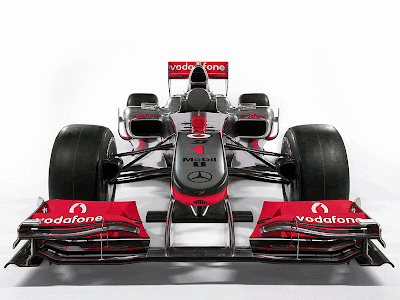
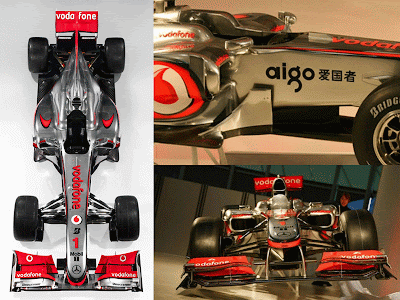
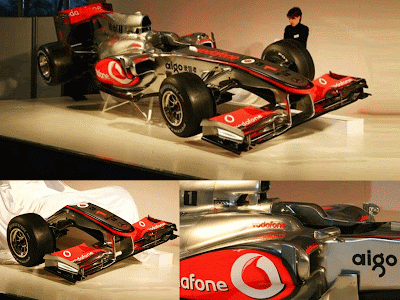
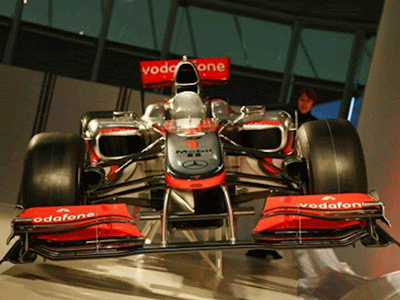
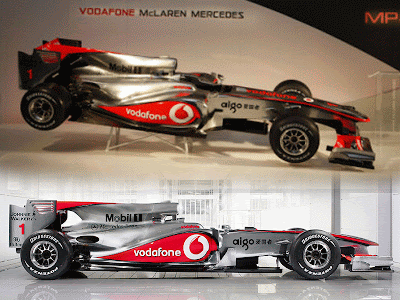
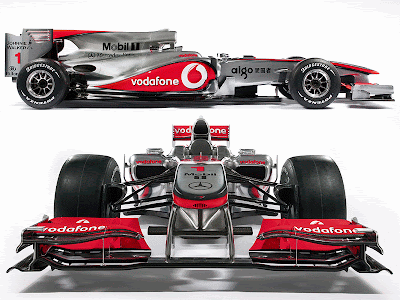
2010 McLaren MP4-25 Race Car
2010 MP4-25 McLaren Formula One Car

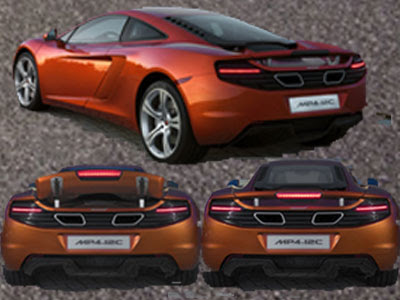
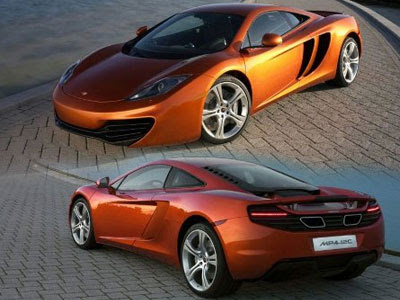
2011 McLaren MP4-12C Super Sports Concept Car pure McLaren, Powered by a twin-turbocharged 3.8 litre, V8 Engine

The independent car division based at the McLaren Technology Centre in Woking, England,the McLaren MP4-12C is revealed as the first in a range of high-performance sports cars from McLaren Automotive.The 12C, and future models within the range, will challenge the world's best sports cars, benefiting from the expertise and virtuosity of the McLaren Group.
Through a rich modern history, McLaren's automotive division has already built the world's most critically acclaimed supercar, the McLaren F1 (1993-1998) and the world's best-selling luxury supercar, the Mercedes-Benz SLR McLaren (2003-2009). McLaren Automotive now looks to the future with a new range of revolutionary sports cars.

The first car from the new company, the McLaren MP4-12C, is a high performance two-seat mid-engine model in the 'core' sports car market segment for cars costing between £125,000 and £175,000.It goes on sale through a dedicated, worldwide retailer network in early 2011.
All the parts of the McLaren MP4-12C are bespoke and unique to this car. Everything from the engine right down to the tailor-made switches and buttons is pure McLaren: nothing has come from another manufacturer's parts bin.

"The 12C is all about performance," said Sheriff. "And in McLaren, we have a very broad definition of performance. We don't just look at the traditional one-dimensional parameters like top speed, we focus equally on useable measures such as in-gear acceleration times, braking performance in all conditions, and efficiency of power delivery combined with the lowest possible fuel consumption and CO2 emissions. Sure, 12C is very fast, but it is also the most efficient, most driveable high-performance sports car in the world.
Thorough engineering and market research led to concept development and a clear decision in favour of a mid-engined two door high performance sports car. Intensive work was carried out in the wind tunnel and the driving simulator to ensure that the new car would inherently have superb dynamic qualities.
The McLaren MP4-12C design follows similar principles to McLaren's Formula 1 cars, and the legendary McLaren F1, where everything is for a reason and all lines, surfaces, and details are designed with a job in mind as much as styled. This ensures that the 12C communicates its engineering through its styling and will remain timeless as a piece of automotive design.
"By the time the 12C is launched in 2011 we expect the economic conditions to be much improved. We have already seen significant interest in the car and the supply of the 12C will be relatively scarce; in its first year we plan to produce just 1,000 cars which represents only 3.5 per cent of the 'core' market," explained Antony Sheriff.

The McLaren MP4-12C is powered by a twin-turbocharged, 3.8 litre 90° V8 engine - the 'M838T'. This marks the start of a new era in 'core' segment sports cars - smaller capacity, lighter weight, higher efficiency and more economical power units. The engine has the highest specific power output in its segment which, when allied to its low weight carbon composite chassis, delivers exemplary power- and torque-to-weight ratios.The McLaren engine revs to 8,500rpm, has quick transient throttle response and delivers its abundant torque throughout the rev range. A staggering 80 per cent of torque is available at below 2,000rpm, ensuring great driveability and no need to floor the throttle to deliver performance.
The McLaren MP4-12C has been designed around a demanding mechanical package that puts emphasis on aerodynamics, compact dimensions, performance and efficiency, practicality and comfort. Although the design of the 12C was driven by aerodynamics, it aims to remain contemporary and elegant throughout its lifetime as well as distinctive among its peers.
"The 12C design was therefore led by aerodynamics. At McLaren we have been able to use the Formula 1 techniques and the huge expertise that the company has amassed at the pinnacle of the sport," explained Stephenson.
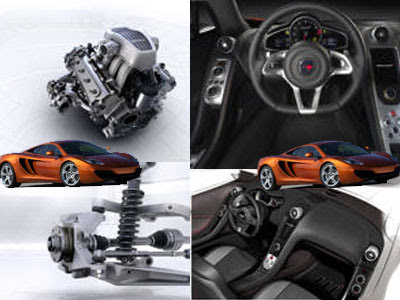
Aerodynamic efficiency drove the 12C's design. High downforce helps maintain traction, cornering ability and stability while low drag aids top speed and acceleration. It has a completely flat underbody and smooth upper body surfaces to yield a highly effective drag coefficient and generate very high levels of balanced downforce at high speed.
2009 LM5 McLaren Concept Car by Matt Williams

The LM5 was designed as a vehicle which could rekindle the drama and sophistication of the legendary McLaren F1. And while McLaren have since revealed the MP4-12C supercar, it's not exactly in the same league as the technological tour-de-force which was the original F1.
The McLaren LM5 is a concept created by Matt Williams, a graduate of Coventry University's Transportation Design degree program. The LM5 was produced as his final year project.
The styling of the F1 was primarily dictated by function. However it also retained a unique sense of character and presence. Williams thought it would be interesting to develop the brand identity of McLaren - but more specifically the F1 model - and bring it into the 21st Century. And while the LM5 concept was designed to offer a similar personality and overall stance to the F1, it was also designed to utilize more extreme and race-influenced bodywork.

The McLaren LM5 concept features the same three-seat layout with a central drivers seat as the old F1. All three sports seats have an extremely slim profile to reduce weight and free up interior space, and instead of conventional safety belts all the seats feature racing-style four-point harnesses. The multifunction steering wheel features a central display for the tachometer.
The proposed engine for the McLaren LM5 concept is a worked over 5.0 litre V10 sourced from BMW. Mounted midship in the carbon fibre pre-preg chassis this unit would make the LM5 a force to be reckoned with on both road and track.
While the LM5 is at the moment just one man's idea of what the F1's successor could look like, the design itself uses both past and present McLaren influences giving it a sense of realism. And It's important to remember that McLaren themselves have made it public knowledge that they're working on developing a successor to their most iconic car within the next couple of years.
SLR McLaren Mercedes-Benz Sports Car

This sports car combines the old yet astounding SLR race cars of the 50s and the latest and meanest technology of high-performance supercars. With the power of race cars and the sleek, curves and designs of a luxury car, the combination from the two car manufacturers is hard to beat.A blast from the past and a taste of the future, this might just be a good description of the latest sports car that came out from a collaboration of Mercedes-Benz and McLaren, two big giants in the car manufacturing industry. We're talking about the 2004 Mercedes-Benz SLR McLaren.
This supercar is definitely fast. SLR McLaren sports a 626-horsepower supercharged 5.5-liter V8. Also, it has a full carbon-fiber monocoque, features crash structures and body panels. And with the supercharge V8 engine, you can see the 2004 Mercedes-Benz SLR McLaren go from naught to 60 miles per hour in less than 3.6 seconds. Top speed has been measured to exceed 200 mph, a feat that can only be achieved by very few even among the high performance sports cars. It was the high-performance division of Mercedes-Benz which created the V8s. The AMG were the ones who hand-build the supercharged V8 engines with top notched precision and quality. It is not at a big surprise to see the supercharged 5.5 (5439 cc) liter dry sumped 90 degree V8 engine to produce around 466.8 kW at 6500 rpm (626 hp) and 780 N·m (575 ft·lbf) torque at 3250 - 5000 rpm. The numbers maybe daunting but the sound of the engine will appease the minds of those who long for the perfect high performance cars.

Mounting that V8 engine into the body of SLR exotic car is also not as traditional as one would like to expect. The engine in SLR sports car is placed in a front mid-engine position just behind the front wheels. Instead of using the traditional oil-pan, dry-sump lubricants are used. With this innovation, it is highly possible to mount the engine to a level that used to be unachievable. Because of the low position of the engine in the supercar's body, the results are more than one hoped. The new Mercedez-Benz SLR McLaren race car has better aerodynamics and better handling due to the lower center of gravity.
Not only does the mean features of the sports car that attracts attention but how the two car companies were able to fuse their own traditions and expertise into a single exotic car. For one, McLaren's expertise in Formula 1 has been imbibed wholly by the SLR's design. The composition of carbon fiber material that was used in the body of the new SLR sports car is so Formula 1. Because of this body, the Mercedes-Benz SLR McLaren has become more rigid and surprisingly strong.
The SLR also has a five speed automatic transmission. There are modes, the Sport, Comfort and Manual which basically covers every known driving style. Sport is for everyday use, Comfort for bumpy or slippery roads, and Manual gives you control over the gears either through the touchpad or the levers on the steering wheel. When you use Manual, you open up three more modes, namely Sport, Supersport and Race. Speed increased significantly as you go up shifts.
With all these features it is not surprising that the Mercedes-Benz SLR McLaren is classified as a sports car and a supercar. Remember to get this right, though, the "SLR" does not stand for "Sportlich, Leicht, Rennsport" which is German for "Sport; Light; Racing" as most people think. Its real meaning is "super-leicht, Rennsport" which means "super-light, racing." The sports car is being sold with a base price of €443,066 £300,000 or $450,000.
2011 McLaren MP4-12C Super Sport Concept Car
Double mid McLaren MP4-12C was completed “in one piece” carbon chassis, which carries the aluminum and special plastic body panels. Eight-installed 3.8-liter engine with an angle of 90 degrees to the collapse of the cylinders and the two turbines. Its capacity is about 600 horsepower and maximum torque is 595 Nm (80 per cent of which is already available from 2000 rpm).
The motor will be used with the seven-Graziano robotized transmission with dual-clutch transmission and a choice taxied. According to preliminary data from the ground up to “hundreds” McLaren supercar will drive for about three seconds. Its top speed of 320 kilometers per hour.
Sales of McLaren MP4-12C, which is scheduled to release a limited edition of one thousand copies, will be no earlier than 2011. The car will do to the markets of USA, UK, Germany, Europe and the Middle East.