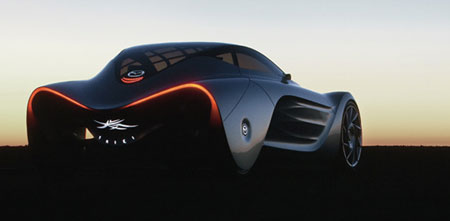
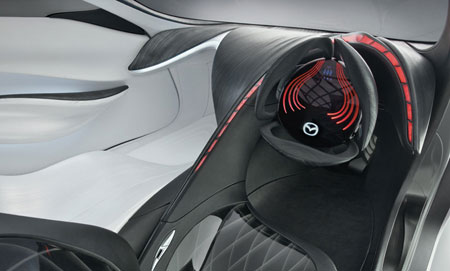
Mazda’s latest series of concept cars seem like odd organic cars that do not look like it may make it’s way into production form anytime soon, and the latest is the Mazda Taiki concept which continues to follow the Nagare theme established with the first car in the new concept line, the Mazda Nagare. Nagare means flow, and Mazda turned to nature for inspiration - using cues from natural flow lines all around us - shapes in sand dunes etched by the wind, ocean waves, lava flow down a volcano, and etc. All three design centers - US, European and Japan contributed to this series of concepts, with cars like the original Nagare coming from the US-based design center and the Mazda Ryuga from the Hiroshima Design Center in Japan. The Mazda Hakaze design concept came from the European Design Center. The Mazda Taiki is the fourth in the series, and this one comes from the Hiroshima Design Center team led by Chief Designer Yamada Atsuhiko. Every concept car represents a different segment of future cars, for example the Mazda Ryuga was envisioned as a future compact car. The Mazda Taiki points to a possible future design direction for Mazda sports cars. The stretched coupe has short overhangs and its interior has a liberating and free feel to it thanks to an all-glass canope. It has a drag coefficient of 0.25 and zero lift. Air is channeled through the front fender via a tunnel formed between the body and the rear fender - this creates downforce. This design concept is also used to unveil some technical goodies. The 2-seater Mazda Taiki is conceptually powered by the next generation RENESIS rotary engine engine called the RENESIS 16X. The engine will be mounted at the front and will power the rear wheels, a proven formula for a sports car. More details on that engine will come in a later post, but you’ll be pleased to know that Mazda is the latest manufacturer to jump on the twin clutch bandwagon. The RENESIS 16X engine will be mated to a 7-speed dry twin clutch transmission. Suspension is a double wishbone setup for both front and rear, and the car rides on 22 inch Enkei wheels wrapped with Yokohama Advan Super-E spec Prototype 007 tyres in 195/40R22 size. As for dimensions, the Mazda Taiki is 4620mm long, 1950mm wide, 1240mm tall and has a wheelbase of 3000mm.
Audi R8 Hyper Black Edition
Anderson Germany, one of Europe's lesser known tuning firms, has set their sights on the flagship version of the Audi R8 Hyper Black Edition. The tune includes both aesthetic modifications and a few modest performance upgrades.
BAC Mono
Briggs Automotive Company, launches with the BAC Mono - a high-tech single-seater. Powered by a 2.3-litre 230bhp Cosworth engine, the £80k BAC Mono is the first serious attempt to produce a single-seater driving experience for the public road.
BMW 6-Series Sportcar Coupe
The BMW 6 Series Coupe has a classy and comfortable cabin, and it's available with excellent engines. The diesel is particularly impressive, combining strong performance with average economy of more than 50mpg.
Brabus BiTurbo 700
Powered by the new BRABUS twin-turbo engine with 700 hp (690 bhp) and a peak torque of 850 Nm and clad in the thrilling WIDESTAR wide-body version the Mercedes SLS AMG from BRABUS ascends to a new level in the league of super sports cars.
Koenigsegg Agera R
The Agera R built upon the features and functionality of the Agera with new, unique solutions to enhance both performance and visual appearance even further. The first Hypercar manufacturer to take steps toward green technology with the release of the biofuel CCXR in 2007.
McLaren MP4-12C GT3 Racer
The GT3 racer features the same 3.8-liter twin turbo V8 engine (known internally as the M838T) but with just 493bhp instead of the series 592bhp. Also gets a race suspension and borrows some F1 technology such as for the steering wheel, seats, tires and electronic systems.
Porsche 918 Spyder
The Porsche 918 Spyder is a mid-engined plug-in hybrid sports car designed by Porsche. The Spyder is powered by a naturally-aspirated 4.6 litre V8 engine, developing 608HP, with two electric motors delivering an additional 279HP for a combined output of 887HP.
Mazda taiki concept
Mazda’s latest series of concept cars seem like odd organic cars that do not look like it may make it’s way into production form anytime soon, and the latest is the Mazda Taiki concept which continues to follow the Nagare theme established with the first car in the new concept line, the Mazda Nagare. Nagare means flow, and Mazda turned to nature for inspiration - using cues from natural flow lines all around us - shapes in sand dunes etched by the wind, ocean waves, lava flow down a volcano, and etc. All three design centers - US, European and Japan contributed to this series of concepts, with cars like the original Nagare coming from the US-based design center and the Mazda Ryuga from the Hiroshima Design Center in Japan. The Mazda Hakaze design concept came from the European Design Center. The Mazda Taiki is the fourth in the series, and this one comes from the Hiroshima Design Center team led by Chief Designer Yamada Atsuhiko. Every concept car represents a different segment of future cars, for example the Mazda Ryuga was envisioned as a future compact car. The Mazda Taiki points to a possible future design direction for Mazda sports cars. The stretched coupe has short overhangs and its interior has a liberating and free feel to it thanks to an all-glass canope. It has a drag coefficient of 0.25 and zero lift. Air is channeled through the front fender via a tunnel formed between the body and the rear fender - this creates downforce. This design concept is also used to unveil some technical goodies. The 2-seater Mazda Taiki is conceptually powered by the next generation RENESIS rotary engine engine called the RENESIS 16X. The engine will be mounted at the front and will power the rear wheels, a proven formula for a sports car. More details on that engine will come in a later post, but you’ll be pleased to know that Mazda is the latest manufacturer to jump on the twin clutch bandwagon. The RENESIS 16X engine will be mated to a 7-speed dry twin clutch transmission. Suspension is a double wishbone setup for both front and rear, and the car rides on 22 inch Enkei wheels wrapped with Yokohama Advan Super-E spec Prototype 007 tyres in 195/40R22 size. As for dimensions, the Mazda Taiki is 4620mm long, 1950mm wide, 1240mm tall and has a wheelbase of 3000mm.
2009 Mazda RX-8 PICTURES AND INFO
2009 Mazda RX-8
Mazda RX-8
The rear doors open in opposite direction to the front. Given this circumstance, access to its rear seat is more comfortable than those of any other coupe on its size. Its length is 4.46 m.
Mazda RX-8
The Mazda RX-8 has a rotary engine of 231 hp maximum power with a six-speed manual transmission. It is the same as the model is still sold, with minor changes in the lubrication system. It is the only engine available for the new Mazda RX-8, therefore, there is no version of 192 hp.
Mazda RX-8
According to official data the Mazda RX-8 achieves 234 km / h, accelerates to 100 km / h in 6.4 s, in conditions of approval, and spends 11.5 l/100 km for petrol.
Mazda RX-8
It has a high power consumption, which also does not weigh much. The cars of similar characteristics (none of them have rotary engine) spend a lot less fuel.
Mazda RX-8
The Mazda RX-8 model 2010 comes with a set of decorative elements in the body as an input of large air or on the front spoiler in the final part of the body.
Mazda RX-8
According to Mazda, as well as fulfilling a decorative function, play a role aerodynamics. Does not appear that the new model has less aerodynamic drag at forward because there is more speed to the model it replaces, or use less fuel.
Mazda RX-8
Other changes in appearance are the tires that are 19 "in diameter (made of forged aluminum), changed the headlights and pilots (who are now LEDs) and exhaust are larger.
Mazda RX-8
The dashboard is different. Instrumentation, is now a variable red zone, which is more or less extensive depending on the temperature of the engine (BMW also uses a similar system on some models). The steering wheel and seats, also manufactured by Recaro, are new. The body can be painted in four colors.
Mazda RX-8
The equipment includes air conditioning, stability control (DSC), connection 'Bluetooth' for the phone, web browser, access system and keyless start, leather upholstery, heated front seats and electric adjustment for the driver's seat. Optionally you can have limited slip rear differential and adjustable dampers harder than standard.
Mazda RX-8
The most important engine of the Mazda RX-8 from the previous 2010 model, is in the lubrication system. The oil pump is driven by an electromagnetic system (instead of a mechanic) and is placed in a different place.
Mazda RX-8
The capacity of engine oil changes from 6.9 to 7.0 l and the letter has a different design to improve the lubrication when the lateral acceleration is very high. The rod is used to control the amount of oil is now located on the deck of the engine (the previous model had a side of the engine and it was difficult to insert in its housing).
Mazda RX-8
According to Mazda, the inlets on the front of the body are higher than the previous model, the oil is cooled more equal speed (low temperature 6 º to 234 km / h, which is the maximum speed).
Mazda RX-8
The Mazda RX-8 has a more rigid chassis structure, changing the bar joining the support of the front springs (now trapezoidal section, instead of round). This new bar, along with other changes in the structure, makes the body of the Mazda RX-8 2010 is stiffer than the previous model.
Mazda RX-8
The wheels have a different alignment and one arm of the rear suspension is slightly thicker to better monitor the adjustment of convergence. The cushions are manufactured by Bilstein. The fuel tank has more capacity (65.4 instead of 61.8 l l).
Mazda RX-8
In the transmission system there are three changes. First, the manual gearbox six marches is different (as Mazda is similar to that of the MX-5, albeit with some changes, as the engine of the Mazda RX-8 has more power).
Mazda RX-8
Second, the shaft (the part that transmits power from the gearbox to the rear differential) is more rigid (about 30%). Third, the rear differential has been changed now because a larger reduction (according to Mazda), but the final development of the Mazda RX-8 (32.2 mph 1,000 rpm) remains similar to the previous model.
Mazda RX-8
This may be due to the reduction that makes the new gearbox is smaller than before, thus compensates for the further reduction of the differential.
ALL TYPES CARS MAZDA PICTURES
Mazda 323F picture
Mazda 323 BG 1985 picture
Mazda 323F (2000 2003) picture
MAZDA 323 1998 picture